Renters’ Rights Act fails young people as rampant discrimination from landlords has ‘devastating’ consequences
Young people desperately trying to move from homelessness accommodation to independent living are battling discrimination from private landlords due to their age, profession, current address, lack of a guarantor or income level, with the Renters’ Rights Act failing to provide young people with fair access to housing.
Discriminatory practices by private landlords or letting agents in the past 12 months have been reported by 77% of 10 youth homelessness charities in the EveryYouth Network, including in England’s South East and South West, Bristol and Northern Ireland.
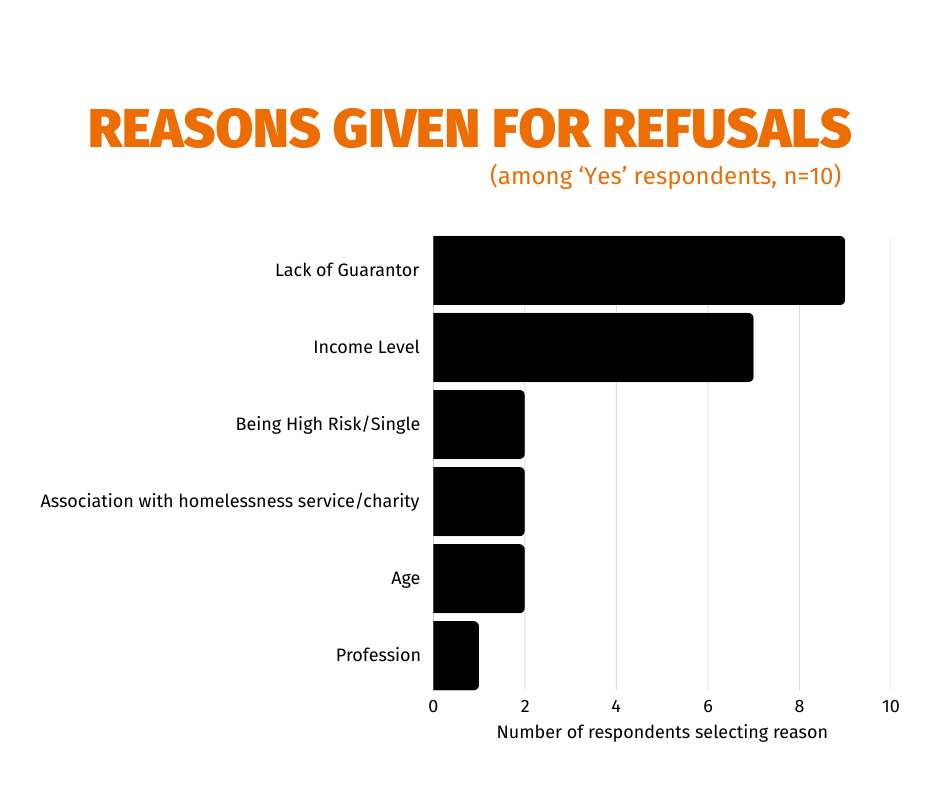
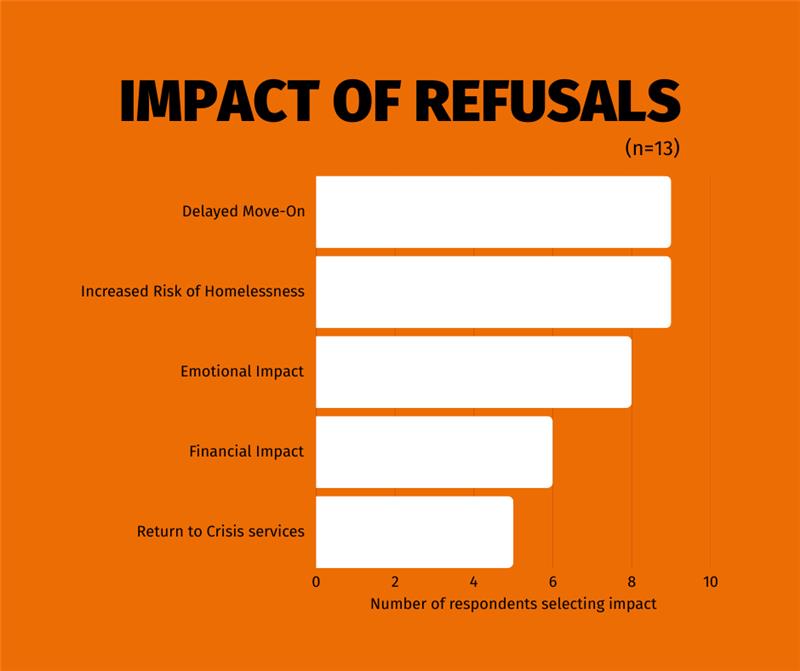
Charities say young people face discrimination mainly due to not having a family member who can be a financial guarantor (90%) or their income level (70%), despite being able to afford the rent. Almost 70% of frontline workers say discrimination is causing delayed move-on from supported accommodation and increased risk of homelessness.
Kalvin, 18, has struggled to find a landlord that will accept him in Devon
As young people face “blanket rejections” from landlords, more are forced into street homelessness, sofa surfing in dangerous situations, or are at risk of exploitation due to desperation, charity frontline housing officers warn.
A young person who is being supported by EveryYouth’s partner charity in Northern Ireland, MACS, reports sleeping in his car because landlords are refusing him due to his association with the charity. Another young person, originally from Bulgaria, was told by a landlord that he would have to pay a £4,000 deposit due to previous experiences of “their culture”.
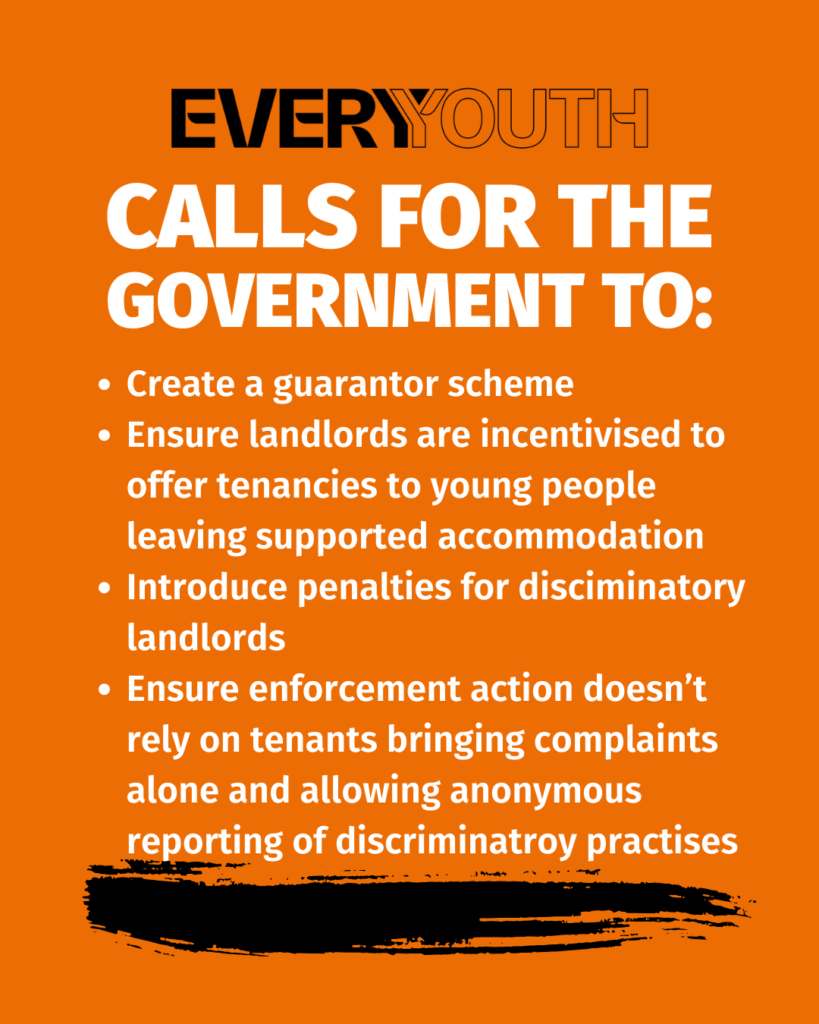
EveryYouth calls on the Government to introduce meaningful penalties for landlords and housing agents who discriminate against young people, and to ensure enforcement action doesn’t rely on tenants bringing complaints alone.
CEO Nicholas Connolly says: “Charities in our network urge the Government to record and monitor refusal patterns among landlords to identify discrimination, allow anonymous reporting of discriminatory practices, and create government-backed or local authority-backed guarantor schemes to prevent blanket refusals based solely on a young person’s lack of a guarantor.”
Copyright: EveryYouth
Rosie, 19, works 35 to 45 hours a week at a pub in Hampshire. She left a “toxic and abusive” family household when she was 17 and moved into supported accommodation provided by her local EveryYouth partner charity, Step by Step. When she was ready for independent living, Rosie and her support worker started looking for available rooms in the area so she could stay near to her work. It took eight months before a landlord accepted her.
“I was consistently turned down because of my age or because Step by Step was put on my application [as my current address]. One [landlord] did outright tell me they didn’t want to take me because ‘they know what kind of people end up in Step by Step’ and other landlords beat around the bush and say, ‘We don’t think this house share is for you’.
“I’ve also been given the reason that because I don’t earn 30x the amount I’d have to pay for monthly rent, in a year, that they won’t take me on, or because I don’t have a guarantor. I work 40 hours a week, it’s not like I can’t afford these places.”
Rosie says: “I have been fully employed, full time, since I was 17. It does feel quite condescending. I can’t help the situation I’m in. Landlords should be considering how much you earn and if you can pay the rent. Instead they’re just considering the fact that I’m under the age of 20.”
Copyright: EveryYouth
Kalvin, 18, has also struggled to find a landlord that will accept him. After moving to Devon from Scotland, he was forced to live in a caravan while he worked and looked for an available room. He is now living in supported accommodation provided by EveryYouth partner charity, the Amber Foundation.
He says: “There have been multiple occasions where I’d see a place I really, really liked and they wouldn’t accept me because I was too young. It was very difficult to get somewhere that I could stay and call home. I had to get a flat that was two hours away from work when I was in Scotland because that was the only place that would take me.
“Even here in England it’s also extremely difficult. Places say ‘you’re too young’, or ‘you get paid a certain way’ or ‘you do not paid enough’ and they question your income. It put a lot of stress on me.”
“There have been multiple occasions where I’d see a place I really, really liked and they wouldn’t accept me because I was too young. It was very difficult to get somewhere that I could stay and call home.”
Kalvin, 18, in Devon
Another young person in Bristol, 21, who wanted to remain anonymous, says: “I’ve also been told that I’m too ‘too high risk’ because I’m single and young. I feel stigmatised for being young and people assume I am irresponsible when actually, I feel that because of having to look after myself from a young age, I am more responsible than a lot of people older than me.”
From May 1, the Government will start to roll out the Renters’ Rights Act, which aims to give 11 million renters stronger rights and better protections. Although it will become illegal for private landlords in England to refuse tenants who receive benefits or have children, there are no specific protections for young people facing discrimination for other reasons.
Frontline support workers fear in reaction to the changes, landlords will increase rents to price out those who are in receipt of benefits, or will sell their homes, leaving less available for renters. Frontline workers say young people are unaware of their rights or how to report landlords for wrongdoings.
Step by Step CEO Debbie Moreton says discrimination will continue behind closed doors unless penalties are imposed on landlords.
“We see young people across our services being refused because they’re under 25 or don’t have a guarantor – barriers that have nothing to do with whether they can be a good tenant. The impact is devastating. Young people stay stuck in homelessness for longer, are pushed into unsafe or exploitative situations, or cycle back into crisis services because the private rented sector is effectively closed to them.”
Dom Wood, CEO at 1625 Independent People, a youth homelessness charity in Bristol, says: “Landlords often perceive young people as more of a financial risk and make decisions based on this – with greater security of tenure [under the Act] landlords could become more risk adverse in this market.
“For young people, particularly those in lower income roles, we need a different model of housing such as Future Builders that recognises the need for truly affordable rents for those who cannot live at home.”
Sarah Johnson, Head of Operations at the Amber Foundation, which supports young people across England’s South West and South East, says: “Discriminatory practices in the private rental market are directly contributing to blockages across homelessness services nationally. Without strong enforcement and clear protections against discrimination, many young people will continue to be excluded before they even reach the point of signing a contract.
“Lawmakers must strengthen protections against discrimination linked to age, mental health, substance misuse recovery, and offending history, and ensure landlords are supported and incentivised to offer tenancies to young people leaving supported accommodation.
“Many of the young people we support have faced significant challenges early in life. What is often misunderstood is that these young people have already demonstrated resilience and accountability, yet they are frequently judged on their past rather than their progress, which can be deeply demoralising and damaging to their confidence.”