A job alone isn’t enough to get young people off benefits – here’s what actually helps them find independence
By Michelle Blackburn, Project Flourish Lead at EveryYouth
Latest figures show that almost one million young people aged 16-24 are unemployed. It’s the country’s highest youth unemployment rate in over a decade and the first time on record that the UK’s unemployment rates exceed the European average.
In response, the Government has introduced a Jobs Guarantee scheme, aiming to get young people off benefits and into employment. This includes subsidising six-month job placements at minimum wage. The scheme is being piloted in six ‘high-needs’ areas from April before a national rollout which is expected to provide more than 55,000 jobs over three years.
But work and pensions secretary, Pat McFadden, has already backtracked on his claim that 60 firms – including JD Sports, Tesco and TUI – have committed to the scheme, clarifying they have only “expressed and interest”. Employers may be initially cautious to sign up because funding grants will be contingent on them offering holistic support for a young person, such as providing a mentor, relevant training, and covering the costs of travel and work equipment.
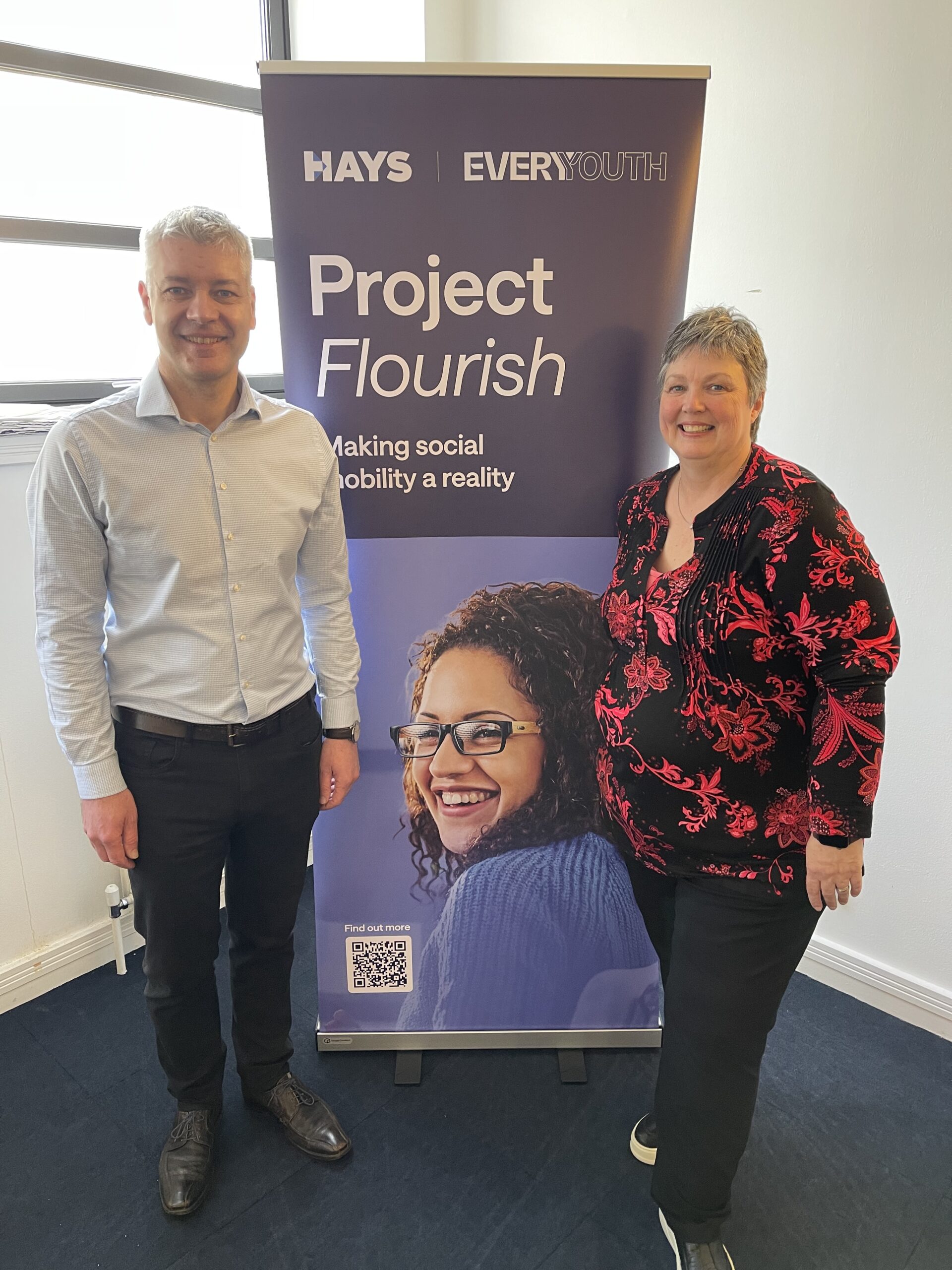
Michelle Blackburn and Jamie Houlders from Hays for Project Flourish
As a national Network of 21 youth homelessness charities, EveryYouth is encouraged to see this holistic support is mandatory and we would jump at the chance to help employers fulfil these obligations because we know the jobs scheme will ultimately need to go hand-in-hand with a pathway to stable housing if the Government truly wants to help Britain’s most vulnerable young people gain independence away from relying on benefits.
For example, a young person on a six-month job placement at minimum wage for 25 hours a week, as offered under the Jobs Guarantee scheme, will struggle to save up for a rent deposit or rent in advance payments for social housing, especially if they have no family support or aren’t living at home.
That’s why we offer an independent living bursary up to £1,600 to young people as part of our employability programme, Project Flourish created in collaboration with global recruitment company Hays. The programme matches young people across the UK who have experienced or are at risk of homelessness with employers to secure them meaningful, permanent jobs at the National Living Wage.
Since Project Flourish launched in 2023, more than 200 job opportunities have been generated. To date, 76% young people have retained their jobs and 41% have moved into independent living. These outcomes show that integrated support helps young people find independence.
“The Jobs Guarantee scheme will ultimately need to go hand-in-hand with a pathway to stable housing if the Government truly wants to help Britain’s most vulnerable young people gain independence.”
One young person started working as a claims consultant through Project Flourish while he lived in supported accommodation. His support worker took him shopping for work clothes, work lunches and train tickets so all of his subsistence needs were met ahead of his first pay cheque.
Four months later he was offered social housing and requested some help towards his rent payments. Project Flourish suggested that he attended a one-to-one financial education session with FinWELL, which helped him look at his new outgoings against his income once he moved. Project Flourish then disbursed £1,622.72 which covered 16 weeks of rent. He passed his work probation shortly after, with a work mentor remarking that “he is flying!” and has slotted well into the team. This is just one example of what happens when employment is combined with housing and financial support.
We also know how vital it is for employers to understand the impact trauma can have on a young person’s employability journey. That’s why all employers signing up to Project Flourish must attend a Psychological Informed Environment (PIE) session with a leading clinical psychologist. We urge the Government to ensure trauma-informed employer training is part of the mandatory conditions of their new scheme.
It’s also vital that young people living in homelessness accommodation will not have their Housing Benefit cut off as a consequence of taking part in the scheme. Without these protections, young people are at risk of being penalised for attempting to improve their situation.
Youth unemployment in rural areas must be prioritised under the scheme as well. Young people in rural Britain are struggling to find jobs that aren’t seasonal, based on zero-hour contracts, or miles away from their accommodation. That’s why Project Flourish operates in Aberdeenshire and Northern Ireland, where these challenges are particularly acute. While the Government’s Jobs Guarantee is first being launched in cities such as Birmingham and Greater Manchester, we urge them to consider prioritising rural areas such as Devon, Cornwall, Norfolk and Suffolk as a priority as well.
It is clear the Government’s ambition to tackle youth unemployment is moving in the right direction. But to truly help young people move off benefits and into independent living, the approach must go a lot further.
Given our understanding, our advice to the Government would be to include:
Access to affordable, stable housing pathways
Financial support for upfront living costs
Trauma-informed employer training
Protection of Housing Benefit for participants
Inclusion of rural communities
A job is an important first step for a young person, but it is not enough on its own. Every young person can thrive if given the right support at the right time. If the Government includes these extra steps into its Jobs Guarantee scheme, the country’s most vulnerable young people will be encouraged to live independently and build a stable future – something that will benefit society as a whole.